
By Agbonavbare Victor omoregbe
Vice President Kashim Shettima, who will represent President Bola Tinubu, at the event, said that the institutions that govern the world must become more representative, equitable, and responsive to the realities of today.
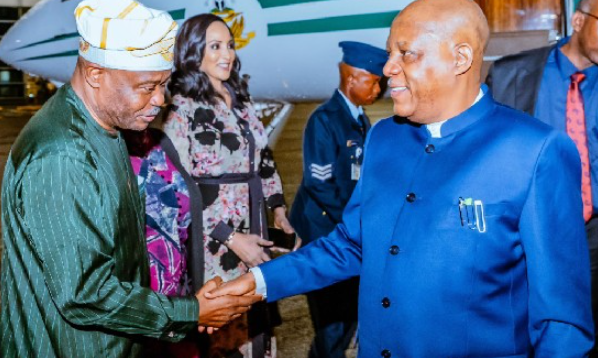
Vice President Kashim Shettima has arrived in New York, United States, to represent President Bola Tinubu and lead Nigeria’s delegation to the 81st Session of the United Nations General Assembly, UNGA.
Vice President Shettima said Nigeria’s engagements at the global gathering would be guided by the country’s national interest, commitment to multilateralism and President Tinubu’s consistent advocacy for reforms of global institutions to reflect contemporary economic and demographic realities.
The Vice President arrived in the company of Governor Siminalayi Fubara of Rivers State; Minister of State for Budget and Economic Planning, Doris Uzoka-Anite, and other senior government officials.
On arrival in New York, Shettima was received by Governor Babajide Sanwo-Olu of Lagos State, the Deputy Chief of Staff to the President (Office of the Vice President), Senator Ibrahim Hadejia; Minister of Foreign Affairs, Bianca Odumegwu-Ojukwu; Minister of Women Affairs, Imaan Sulaiman-Ibrahim; Minister of Solid Mineral Development, Dele Alake; Nigeria’s Permanent Representative to the United Nations, Jimoh Ibrahim, and other senior government and diplomatic officials.
During the General Debate, the Vice President Shettima is expected to deliver Nigeria’s national statement, outlining the country’s position on major international issues and priorities with direct implications for peace and security, development, economic growth and global cooperation.
Senator Shettima will also participate in high-level meetings and hold bilateral engagements with world leaders, international organisations, and development partners on the sidelines of the General Assembly.
Nigeria is expected to use the engagements to reinforce its positions on reform of international financial architecture, sustainable development, climate finance, technology access, and stronger representation for Africa in global decision-making.