
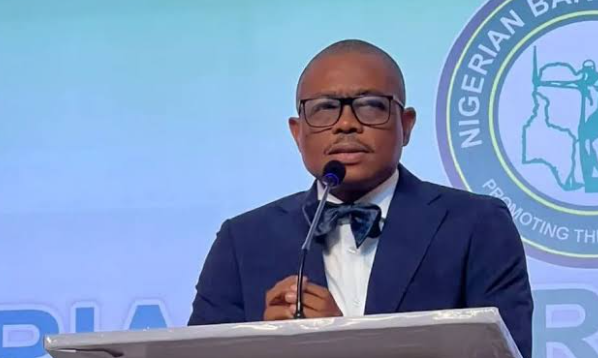
The Nigerian Bar Association has faulted the Economic and Financial Crimes Commission over the reported freezing of Osun State Government bank account, saying the anti-graft agency lacks the constitutional power to impose a blanket restriction on a state’s finances without due legal process.
The NBA president, Afam Osigwe (SAN), in an interview, warned that any directive restricting withdrawals from accounts belonging to a state government would effectively cripple governance and amount to an abuse of power.
Osigwe acknowledged that the EFCC could seek court orders against specific accounts suspected to be linked to fraud but insisted that the commission could not lawfully freeze all accounts belonging to a state government.
He said, “No government agency or any person has the right or the power to restrict withdrawals from the account of any state because, first of all, the order has the effect of grounding the activities of a government. If the EFCC knows that any particular account is being used for the purpose of fraud, it may be able to obtain a court order, but it cannot make a blanket order freezing the accounts of any state.”
The senior advocate added, “Such an order would be unconstitutional and also violate the powers of the EFCC and may actually amount to an abuse of power. We should not have such a situation.”
He maintained that any decision to freeze the account of an individual or government institution must be supported by sufficient legal grounds and a valid court order.
According to him, “If there is a need to freeze the account of a person or government, there is a need to provide a proper basis for it and get a proper order.”
Although he said he was unaware whether the EFCC had indeed issued such a directive, Osigwe advised banks not to comply with any instruction seeking to halt transactions across all state government accounts.
He stated, “I don’t think it would be proper if indeed the EFCC made such an order. I’m not aware of it, but if they made such an order, I would advise that no bank should obey such an order.”
He further urged the anti-graft agency to avoid actions capable of creating the impression that it intended to financially cripple a state government.
Similarly, a Senior Advocate of Nigeria, Adeyinka Olumide-Fusika, questioned the legality of the alleged no-debit restriction, and also insisted that the EFCC must first obtain a court order before freezing any account.
He said Nigerian courts had consistently ruled that anti-graft agencies could not freeze accounts without judicial authorisation.
“There is a no-debit order on Osun State’s account. My question is: Does the EFCC have the power to do that? I don’t think they got any order from the court,” he said.
Olumide-Fusika noted that while the EFCC regularly imposed restrictions on individual accounts, the alleged action against a state government had attracted wider public attention because of its constitutional implications.
He said, “The courts have been consistent on that: don’t do it without a court order. Anybody can go to court to seek an order, but the decision belongs to the court.”
The senior lawyer, however, linked the controversy to the forthcoming Osun governorship election, arguing that concerns over the possible use of public funds for electioneering could have informed the alleged restriction.
He nonetheless maintained that any preventive action must comply with the law.
Also weighing in, Isiaka Olagunju (SAN) described the freezing of the bank account as a serious violation of the 1999 Constitution and contrary to the principles of federalism.
He said, “The EFCC’s action is a serious infraction of the Constitution of the Federal Republic of Nigeria, 1999, as amended. If at all there is an allegation of embezzlement against any official of a state, the EFCC needs to be specific instead of obtaining a blanket order freezing the funds of the state.”
According to him, restricting access to state funds could adversely affect governance and undermine the government’s ability to discharge its constitutional responsibilities.
However, Professor Damilola Olawuyi (SAN) defended the use of account freezing as a recognised preventive tool in tackling economic and financial crimes, provided it is exercised within the limits of the law.
He said, “The EFCC has inherent statutory powers to take anticipatory measures to prevent and eradicate the commission of economic and financial crimes.”
Olawuyi explained that temporary restrictions on accounts had become an internationally recognised mechanism for disrupting illicit financial flows, money laundering and terrorist financing.
He, however, cautioned that such powers “should not be used as a cudgel to settle political scores, neither should they be used as a substitute for proper investigations or a tool to block legitimate transactions.”
Another Senior Advocate of Nigeria, Wolemi Esan, said the EFCC could place a temporary stop order on a suspected account for up to 72 hours without first obtaining a court order under Section 7(6) of the Money Laundering (Prevention and Prohibition) Act.
He explained that any restriction beyond the statutory period must be backed by judicial authorisation.
“If the directive was intended to operate as a stop order for a period not exceeding 72 hours under Section 7(6) of the Money Laundering Act, a prior court order was not required. However, if the EFCC intended the restriction to continue beyond the statutory 72-hour period, it ought to obtain an interim freezing order under Section 34 of the EFCC Act,” Esan said.
Also commenting, Chief Mike Ahamba (SAN) said he was unaware of any legal provision empowering the Federal Government or the EFCC to freeze a state’s account.
“I don’t think there’s such an authority. I don’t know on what grounds they did it. Let us go to court and see what the court says. If they don’t have that power, then people will naturally describe it as harassment,” he said.