
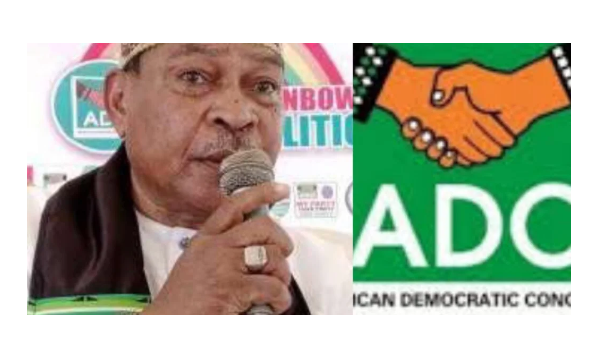
The African Democratic Congress in Ogun State has moved to consolidate its internal authority by reaffirming Femi Soluade as State Chairman, even as it battles a competing faction challenging its legitimacy.
The State Executive Congress held in Abeokuta—and supervised by a national team led by Moshood Salvador—was positioned by party leaders as the only constitutionally valid process. By contrast, a parallel gathering at the Olusegun Obasanjo Presidential Library was swiftly dismissed as illegal, highlighting an escalating struggle for control within the party’s state structure.
Soluade’s unopposed return, alongside newly affirmed executives, signals an attempt to project unity and organizational stability. But the existence of a rival faction underscores a deeper contest over legitimacy—one that could shape the party’s effectiveness heading into the 2027 electoral cycle.
From a strategic lens, this is less about routine party administration and more about ownership of the political machinery. Control of the state structure determines candidate selection, resource allocation, and grassroots mobilization—critical levers in any competitive election environment.
In his acceptance remarks, Soluade leaned into a reform narrative, emphasizing discipline, grassroots expansion, and policy-driven engagement. His focus on economic empowerment, infrastructure, and inclusion suggests an effort to reposition the party beyond internal disputes and toward voter-facing priorities.
However, the path forward hinges on conflict resolution. While the leadership has extended an olive branch to aggrieved members, unresolved factional tensions could dilute the party’s cohesion and electoral viability if left unchecked.
Bottom line: the ADC in Ogun has secured a temporary win on structure, but the real test will be whether it can convert that control into unity—and ultimately, into political capital ahead of 2027.