
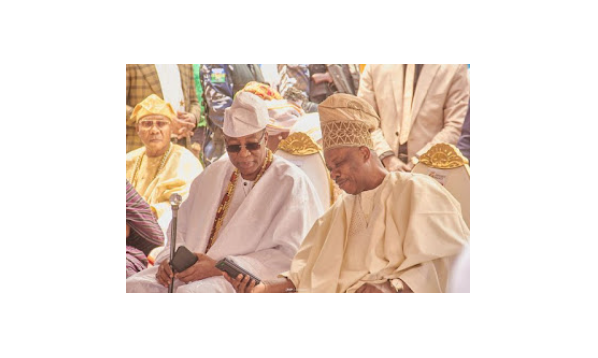
Former Ogun State governor, Gbenga Daniel, has publicly revisited his long-standing political feud with successor, Ibikunle Amosun, revealing that he endured intense persecution during the latter’s administration.
Daniel made the disclosure during his 70th birthday thanksgiving service at the Abraham Tabernacle in Sagamu, offering a rare personal account of the political tensions that defined Ogun State’s leadership transition in 2011.
In a candid reflection, the Ogun East senator described Amosun as an “enfant terrible successor,” stating that their rivalry stemmed largely from Amosun’s strong ambition to become governor—an ambition he said created friction when it appeared he did not fully support it.
“He showed me hell,” Daniel remarked, referencing what many observers have long interpreted as a period of political hostility marked by investigations and legal battles shortly after the transfer of power.
The comments shed fresh light on a chapter that saw Daniel prosecuted by the Economic and Financial Crimes Commission over alleged financial mismanagement involving billions of naira—charges that were eventually dismissed by the courts after years of litigation.
Despite the sharp recollection, Daniel struck a reconciliatory tone, noting that both leaders have since moved past their differences. He disclosed that fences have been mended, with both now aligned toward the broader goal of advancing Ogun State and national development.
The political history between the two figures dates back to their early alliance under the Peoples Democratic Party, before a fallout ahead of the 2007 governorship election forced Amosun to defect and contest against Daniel. Their rivalry climaxed when Amosun assumed office in 2011 and initiated probes into Daniel’s administration.
Daniel’s latest remarks, delivered in the presence of political stakeholders and dignitaries, signal a strategic closure to a once-bitter rivalry—while also reinforcing a wider narrative around political reconciliation in Nigeria’s evolving democratic culture.
From a governance lens, the episode underscores a familiar pattern in Nigerian politics: transitions often accompanied by institutional pushback, followed by eventual realignment as political interests evolve.