
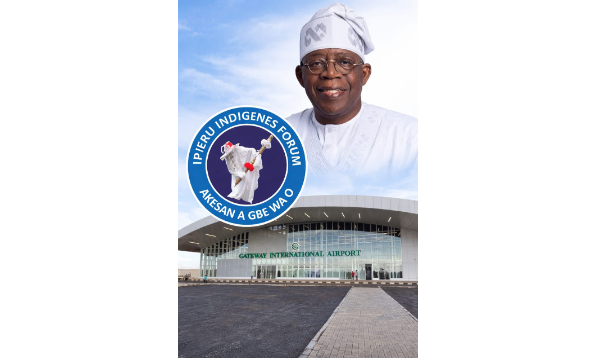
The commissioning of the Gateway International Airport in Iperu is shaping up as more than a ceremonial event—it is being framed as a strategic inflection point for regional industrialization and Nigeria’s broader economic ambitions, with President Bola Ahmed Tinubu expected to headline the inauguration.
The project, championed by Dapo Abiodun, has drawn strong commendation from the Iperu Indigenes Forum, which described the airport as a transformative asset positioning Iperu Remo as a rising aviation and commercial hub.
Set within the expanding Remo industrial corridor, the airport is being positioned as a catalyst for economic acceleration—unlocking opportunities in trade, logistics, tourism, and agribusiness while strengthening Ogun State’s connectivity to global markets. Stakeholders argue that its strategic location will serve as a magnet for investment and a driver of regional competitiveness.
The Forum praised both the federal and state leadership for what it described as a coordinated vision. Tinubu’s “Renewed Hope” economic agenda was highlighted as providing the national framework, while Abiodun’s “Building Our Future Together” strategy and “ISEYA” development model were credited with translating that vision into tangible infrastructure outcomes.
Beyond the aviation milestone, attention is also being drawn to a network of supporting projects designed to maximize the airport’s impact. These include improved road links such as the connection to the Sagamu–Benin Expressway, urban development initiatives like the Aviation Estate, and forward-looking proposals such as the Purple Line Metro Rail linking Mowe to Iperu. Together, these developments signal a broader ecosystem approach rather than an isolated infrastructure investment.
The Forum also stressed the need for complementary reforms to fully unlock the airport’s potential. Key recommendations include improved intra-city road networks, stable power supply, enhanced security within the airport corridor, and deliberate inclusion of local youths in operational and technical roles to drive economic participation and reduce unemployment.
At a community level, the project is being celebrated as a source of pride and identity, particularly for host communities whose lands now house the facility. However, beyond symbolism, stakeholders are focused on execution—ensuring that infrastructure translates into measurable economic outcomes.
If effectively leveraged, the Gateway International Airport could serve as a high-impact economic multiplier, anchoring Ogun State’s ambition to become a leading industrial and logistics hub in Nigeria. The real test now lies in how efficiently the surrounding ecosystem is activated to sustain growth beyond the ribbon-cutting moment.